
Index shows unprecedented transport cost increases
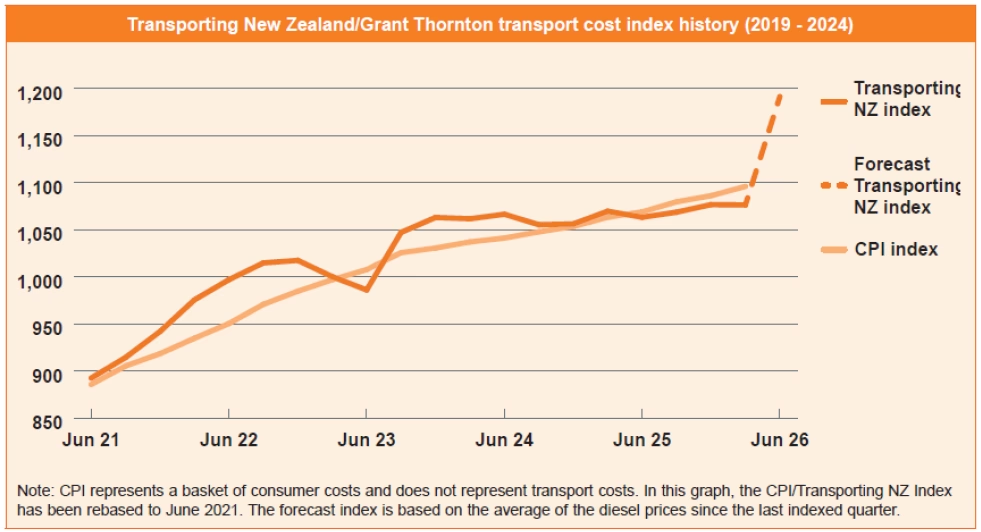
Transport cost index demonstrates unprecedented impact of fuel pricing
We recently released our Grant Thornton Transport Cost Index for the March quarter and that includes forecasting for the following quarter. The magnitude of the rise forecast is unprecedented in the Index’s history and demonstrates the downstream impact of the geopolitical tension in the Strait of Hormuz on transport.
While there seems to have been some cooling in the pricing of crude and refined products landing here, I think there’s still some time to go before we get back to reasonable stability.
Australian regulators showing forward thinking
It was interesting to read reports from Australia about how dramatically its road transport regulatory framework may need to evolve over the coming decade.
Representatives from their regulatory bodies, National Transport Commission (NTC) and the National Heavy Vehicle Regulator (NHVR) are looking ahead to a future that could include automated trucks, data-driven enforcement and a very different approach to regulation.
The NTC said the biggest challenges facing regulators were adapting laws built around the assumption that a human is always driving the vehicle, and when laws would need to clearly define when responsibility sits with a human operator and when it rests with the company providing the automated driving system. This issue has been a bugbear over the last decade or so and I’m surprised it hasn’t been remedied yet.
NHVR CEO Nicole Rosie, formerly CE of NZTA, outlined the NHVR’s vision for a future where compliance activities become increasingly driven by data and intelligence rather than traditional roadside enforcement.
I think it’s good this already appears to be on NZTA’s radar. Given the increase in the availability of on-vehicle monitoring, whether we need to keep spending on roadside compliance infrastructure remains to be seen.
While we share some common issues with our Trans-Tasman neighbours, we need to keep in mind that there is one massive difference which I am concerned is too often overlooked.
Unlike us, Australian transport businesses do not need to obtain a transport service licence, and therefore I think there’s a good case that we don’t mirror everything Australia does. Unless of course we lose the licensing regime in which case common approaches could make more sense.
However, there’s no indication of that. In fact, it’s the opposite situation, as demonstrated by our support for the recent legislative changes that better empowers NZTA to manage those businesses it licenses.
An efficient and effective licensing system should prevent unsafe operators entering the system, which is a growing issue in Australia with “sham” contracting. It should also avoid the problem akin to closing the gate after the horse has bolted.
I was also interested to see officials seeking to reassure diesel operators that they are not subsidising battery-electric trucks. Under the current charging methodology, cost recovery calculations assume all vehicles contribute equally, meaning governments absorb any shortfall created by electric vehicles that do not pay fuel tax.
Bipartisan support for National Infrastructure Plan
The National Infrastructure Plan published by the Infrastructure Commission in February, sets out a pathway for delivering infrastructure needs over the next 30 years, covering things like roads, hospitals, and water networks.
The Plan is something of a wake-up call, a common theme being that there simply isn’t enough money to fund all the infrastructure projects we want.
The Plan notes that New Zealand spends more on transport than on any other infrastructure class, yet transport plans exceed what can be sustainably funded. The Plan estimates it would cost $56 billion to deliver just the major roads programme in full over the next 20 years. If this were funded entirely from petrol tax and road user charges, it would require the equivalent of a 49 cent per litre increase in petrol tax, which it says is unsustainable.
The Government has responded to the Plan by announcing that it supports all sixteen recommendations in the report, and noting the Government response is also broadly supported by the Labour and Green parties.
Clearly, this will be a matter of much discussion for us in the coming months and years.



Didn’t get this by email?
Stay in the loop on the latest road transport news with our weekly Dispatch newsletter, delivered to your inbox every Friday morning.