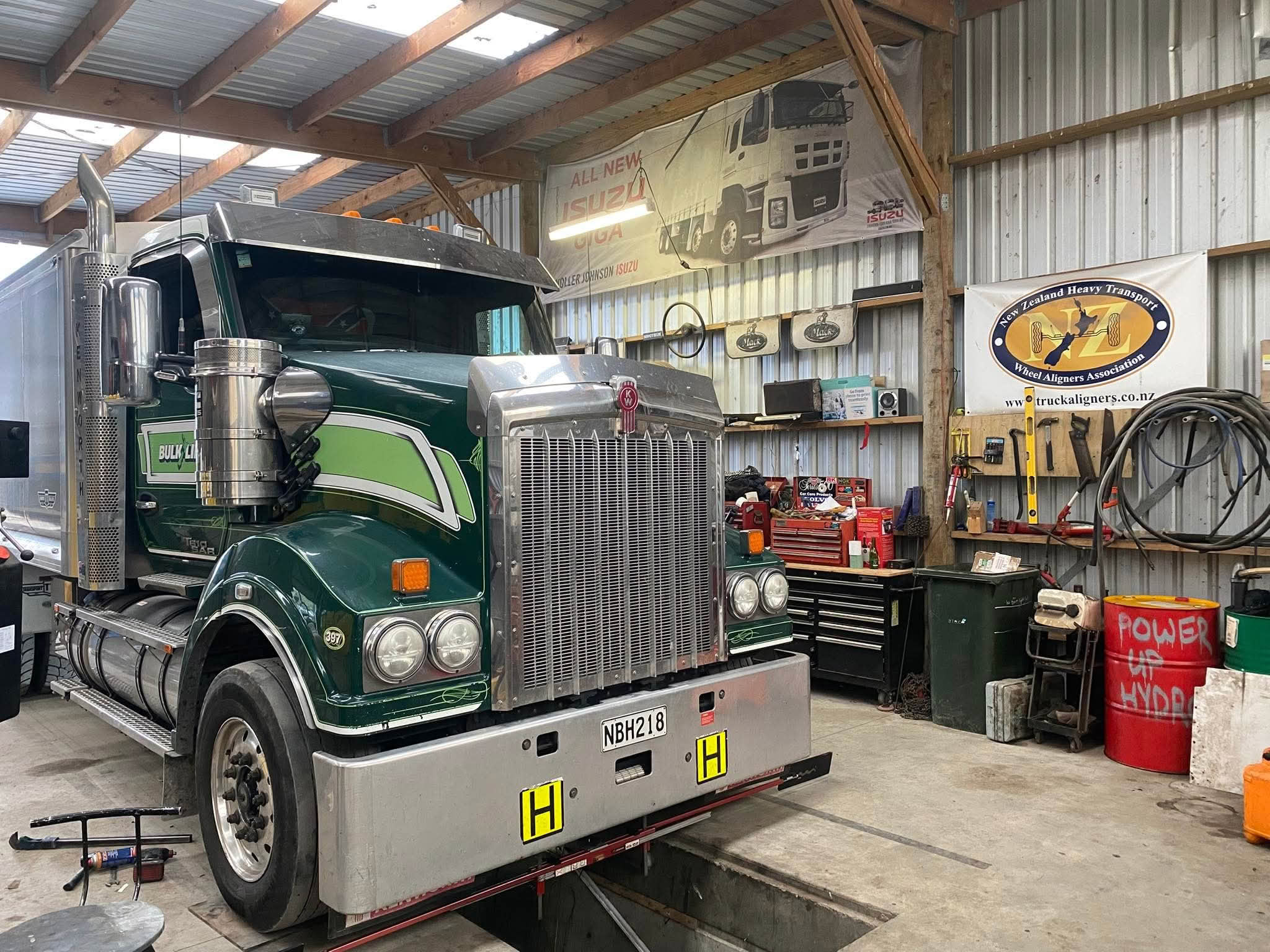
Heavy vehicle wheel alignments must be one of the most overlooked maintenance services that the transport industry faces today. With the increasing deterioration of New Zealand’s roads, component failure and tyre wear are big factors in the life of a truck in this day and age.
Benefits of wheel alignments
A correctly aligned truck will be easier to drive, cause the driver less fatigue, and have better tyre wear, along with better fuel economy. In a time where Health and Safety is at the forefront of importance, heavy vehicle alignments should be an integral part of any truck’s maintenance schedule to ensure that truck is running true, safe and is easy to drive for the operator.
Don’t forget about the trailer
Many people are unaware that trailers also require wheel alignments. An incorrectly aligned trailer can have inconsistent tyre wear, incorrectly track the truck and can sometimes pull the truck sideways, causing the driver to have to compensate for this. This will increase fatigue as the driver has to fight the steering wheel to keep the vehicle on the road.
Before a wheel alignment is commenced, a pre-alignment check is carried out to ensure that the vehicle is in good order. All steering and suspension components are checked for tolerance, including kingpins, tie rods and draglinks, wheel bearings, steer tyre pressure and condition.
Underinflated tyres
More often than not, we are seeing under-inflated tyres what have worn out prematurely due to the underinflation. Tyres that should be running at high pressure usually come in at 70-80psi. A lot of people associate this wear with alignment, but this is not the case.
Even after the alignment has been carried out, the wear pattern in the tyres will cause the truck to pull in the direction of the wear. Sometimes if the wear is not too bad, the tyre can be flipped on the rim or rotated accordingly but most of the time, the complete issue cannot be solved unless the steer tyres are replaced as well.
Wheel balancing
While on the topic of tyres, many people are unaware that heavy truck tyres can also be balanced. An out-of-balance steer tyre will cause a vibration in the cab, usually around highway speeds and if left too long, can cause a scalloping in the tyre as well. It’s recommended that when the steer tyres are replaced that they are balanced at the same time to counter this.
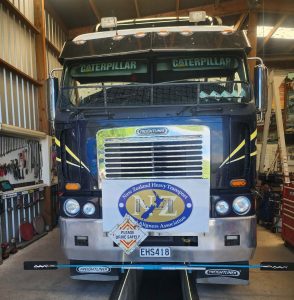
A wheel alignment is recommended to be carried out at the following times:
- Yearly or after 50,000kms of driving
- If you notice uneven or sharp tyre wear
- A steering component has been replaced such as a tie rod end or drag link
- The truck has had a hard impact and you notice that steering wheel is no longer straight or the truck now drives differently
- A trailer axle has been removed and reinstalled
- You notice the trailer incorrectly tracking the truck
What can you do as an operator to ensure that your truck is in good working order?
- Carry out your pre start inspections and note any faults to your supervisor to get repaired
- Check your tyre pressures regularly and tyre dread depths
- Check your tyre condition regularly, if you notice uneven wear – get the truck aligned
- If you notice any major faults – GET IT FIXED
We recommend that heavy vehicle wheel alignments only be carried out by a member of the New Zealand Heavy Transport Wheel Aligners Association. As an association member, they follow the same rules and regulations to ensure that you get the alignment done correctly. All members have the training and expertise as well as a totally professional attitude. With the association tracking 30 years, our members have the knowledge and know-how to fix any issue.
“Setting the standard in heavy transport alignment”