
How can we better support young drivers?
The road freight industry, for all its various great features, is often said to not have a stellar record when it comes to investing in and upskilling our young people. There are some practical reasons why this is that we must tackle to prepare the sector for the future.
The 2025 Road Transport Workforce Report based on census data found that there are almost twice as many truck drivers are over the age of 65 than are 24 and under. While 15–39-year-olds represent 46 per cent of New Zealand’s overall workforce, only 34 per cent of truck drivers belong in the same age range.
It can reasonably be followed that many of New Zealand’s skilled truck drivers will be retiring out of the workforce within the next decade. Meanwhile, young adults are experiencing high rates of unemployment or underutilisation (not working as many hours as they’d like to).
There’s a real opportunity here, but it will require commitment and investment from policymakers and from transport businesses.
With the freight task projected to grow by 55% over the next 20 years, our sector has some serious work to do when it comes to promoting itself and ensuring it’s a great place to work for younger generations.
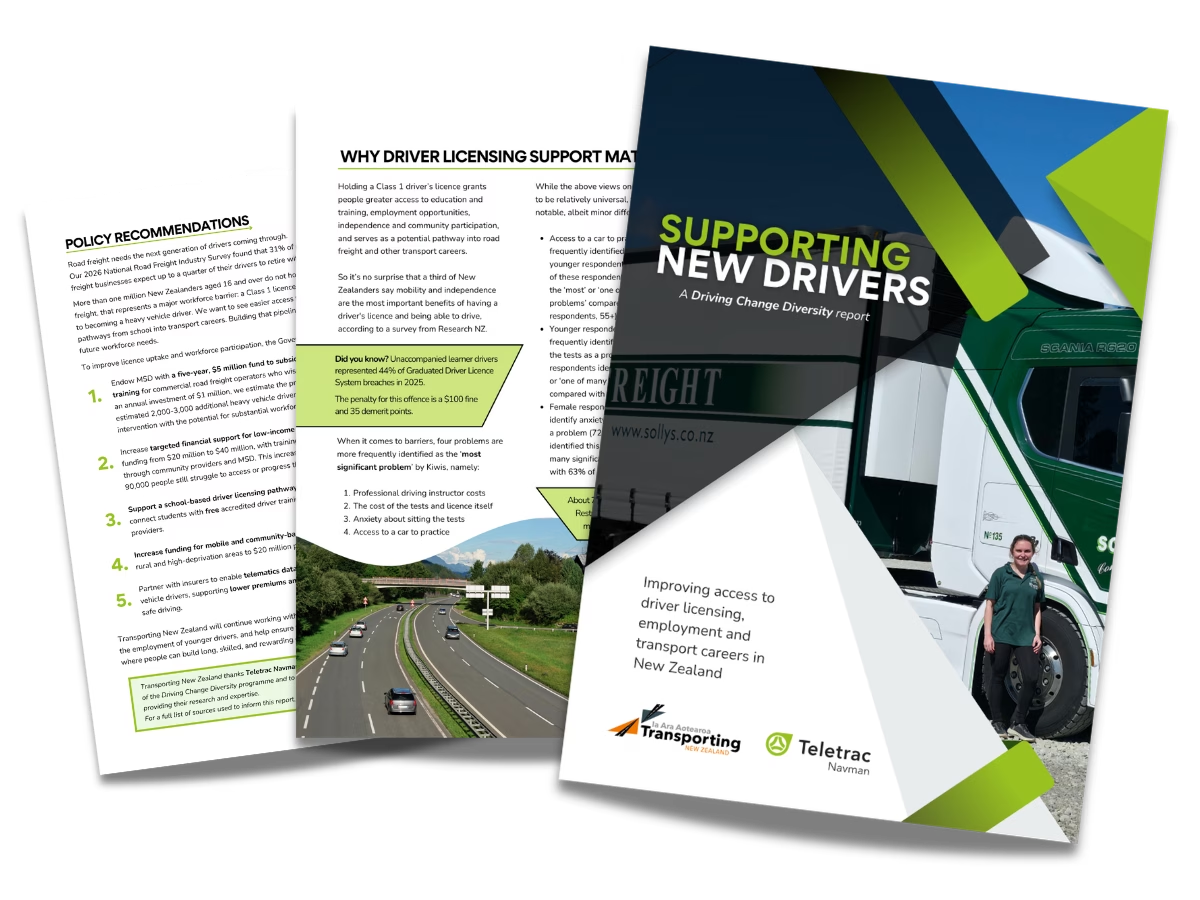
Today, we’re releasing Supporting New Drivers with support from Teletrac Navman. It’s a resource for operators, potential industry entrants, and policymakers to better understand the current pathway to a light or heavy vehicle licence and the barriers some face in getting there.
We largely support work done by the foremost non-profit in this area, the Driving Change Network, who point out that just getting a car licence depends on many factors, such as:
- Access to a vehicle and to a suitable instructor, often a relative
- Ability to pay for professional lessons, for tests and for the licences themselves
- Transport to and from the testing centre (learners cannot drive unsupervised)
Obviously, the path forward to a heavy vehicle licence is often even more expensive and just as time consuming, made more difficult without the guaranteed support of an employer.
But car licences are the first step in the pipeline towards a transport career. That’s why we’re making the following policy recommendations to the Government:
- Endow MSD with a five-year, $5 million fund to subsidise Class 2 and higher licence training for commercial road freight operators who wish to upskill their employees. At an annual investment of $1 million, we estimate the programme could help generate an estimated 2,000-3,000 additional heavy vehicle drivers, representing a small, targeted intervention with the potential for substantial workforce and economic benefits.
- Increase targeted financial support for low-income applicants by doubling annual funding from $20 million to $40 million, with training and testing services delivered through community providers and MSD. This increase takes into account that up to 90,000 people still struggle to access or progress through the system every year.
- Support a school-based driver licensing pathway by enabling secondary schools to connect students with free accredited driver training, licensing, and employment providers.
- Increase funding for mobile and community-based licensing services, particularly in rural and high-deprivation areas to $20 million per year.
- Partner with insurers to enable telematics data to be used in assessing younger heavy-vehicle drivers, supporting lower premiums and excesses for drivers who demonstrate safe driving.
Benefits of implementing these policy changes will far outweigh the costs. As proof of this, you can look at any of the number of existing community programmes that are teaching disadvantaged young people how to drive when they have little other options.
“Social-return-on-investment” assessments found that every dollar invested has produced an estimated return of $3.26 through the Howard League driver programme, $5.10 through Drive My Life-Taraiwa Mataora, and $7.20 through Blue Light’s Youth Driver Navigator Programme. This value is derived from our roads becoming safer, alongside programme participants having increased employment options and incomes, among other positive outcomes.
Collectively, these programmes only have enough funding to reach a few thousand people a year. Meanwhile, there are still a million Kiwi adults with no full licence, and almost half this number have no licence at all. Imagine the potential New Zealand can unlock by further boosting the work that’s proven to produce great results.
Alongside our campaign to get more people driving light vehicles safely and legally, Transporting New Zealand will continue working with our members to promote the road freight industry, support the employment of younger truck drivers, and help ensure that our sector is recognised as one where people can build long and rewarding careers.
Read the full Supporting New Drivers report below.
Produced with support from Teletrac Navman.




Didn’t get this by email?
Stay in the loop on the latest road transport news with our weekly Dispatch newsletter, delivered to your inbox every Friday morning.