
The sizzling final transport election debate of 2026
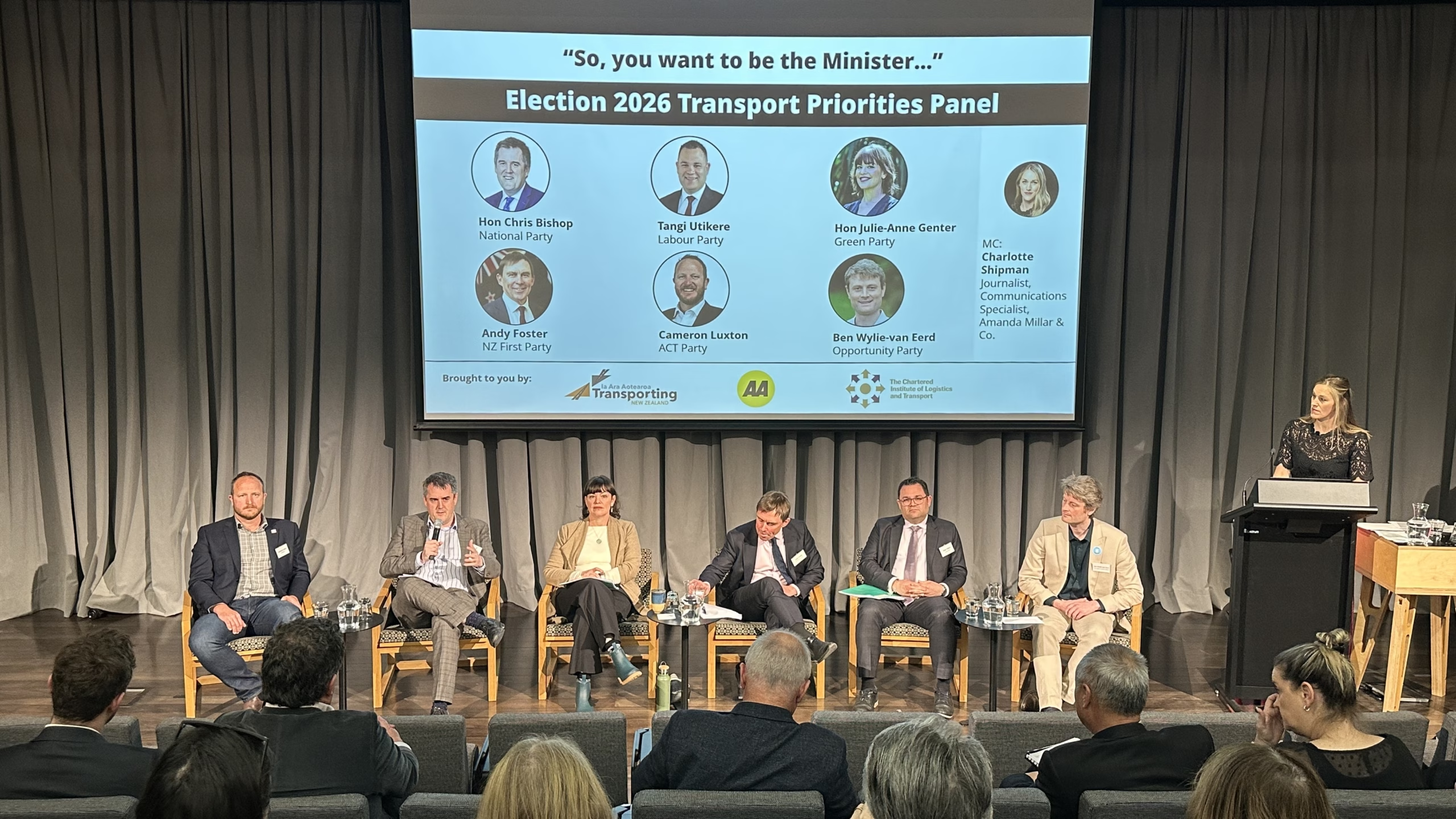
Yesterday, all the political parties polling above 5% debated transport priorities in front of a live audience at a packed-out Wellington event co-hosted by the AA, Transporting New Zealand, and the Chartered Institute of Logistics and Transport (CILT).
The lively discussion, humorously facilitated by MC and former Newshub journalist Charlotte Shipman, revealed several areas of common ground across National, Labour, the Greens, NZ First, ACT and the Opportunity Party.
Prioritising road maintenance, introducing time-of-use charging in Auckland and Wellington, and the need for a new road funding model were unanimously agreed upon by the parties. There was also a strong degree of consensus that NZTA is not currently performing effectively as a regulator.
However, there were still plenty of issues up for debate.
The panel began with all the politicians and politician-hopefuls sharing a transport-related fact about themselves. Highlights included Transport Minister Chris Bishop’s admission that he never owned a car until age 28, and the Greens’ Julie-Anne Genter’s confession that she totalled a parked ute while rolling down the passenger-side window of her Honda Civic as a teenager.
Each panellist had exactly two minutes to share their party’s top transport priorities. Surprisingly little was said about freight. TOP’s Ben Wylie-van Eerd had a number of policies designed to expedite electric vehicle uptake, including accelerated depreciation, mandating that public departments only purchase EVs and that chargers are installed in all new house builds.
ACT’s Cameron Luxton said that when it comes to infrastructure, the most affordable and safe option should be the first choice – bells and whistles can be added later (and preferably not at the cost of the taxpayer). He reiterated his support for toll roads, but was somewhat disgruntled that so far, half of them are in the Tauranga region where he resides.
NZ First’s Andy Foster said maintenance over new projects was the party’s key priority, which was a view shared by the panel. He also pointed out that the South Island road network receives much less investment than the North, and suggested his party would be aiming to rectify this unfairness.
Then it was over to National. Bishop listed a number of achievements over this last term, such as having four Roads of National Significance underway alongside record investment in maintenance, authorising the Infrastructure Commission to investigate escalating costs of major projects, the passing of time-of-use legislation and the planned universal RUC system. There was a fair amount to cover and he went quite a bit over the allotted time.
The Greens’ priorities are to reduce private car reliance through increasing the frequency of public transport services and drastically reducing fares, while focussing the National Land Transport Fund on maintenance and safety, said Genter. Later, NZ First’s Foster pressed Genter on where funding for free public transport concessions and $2 adult tickets would come from. Genter said the Greens had done all the workings and it would largely be covered by the party’s infamous Wealth Tax targeted at the super-rich.
Labour’s Tangi Utikere confirmed that, while he’s not a fan of the “Roads of National Party Significance”, where contracts have been signed and funding has been allocated, Labour will honour those commitments. He said Labour’s recently announced transport policies will ease cost-of-living pressures, including weekly public transport fare caps and freezing the RUC/fuel excise duty rate for three years.
Each of the panellists had an opportunity to ask another a direct question. Bishop challenged Utikere on the RUC/FED freeze, asking what would be cut without the projected $3.1 billion in revenue that planned increases would raise. A straight answer was difficult to ascertain from Labour’s transport spokesperson, but would be revealed in the next Government Policy Statement, should they come to power this election.
Both the Greens and TOP questioned National’s promise to fund Mill Road improvements to the tune of $1.75 billion. Genter accused the plan of being unfunded and not having gone through the formal Infrastructure Priorities Programme. Bishop said the money would come from Budget 2027 or 2028, and it had a good benefit-cost ratio of 3.1 considering the projected population growth in Drury. (This BCR would only apply if the road was un-tolled.) He also said the project had previously been supported by the former Labour government.
He and Genter then argued over whether inter-regional passenger rail was also an unfunded Green Party “fantasy” in Bishop’s words, which Genter strenuously denied. This animated back-and-forth was curtailed by the MC, but Bishop assured her and the audience that most quarrels between the panellists were of the collegial kind – “disagreeing agreeably”.
Five out of the six supported the need for a better road funding model. Bishop also commented that it was widely accepted that NZTA being the regulator, the road builder, and the funder all at once wasn’t working. Maybe we needed to go back to something like when Transit existed, he said.
One of the more interesting moments for us at Transporting New Zealand was the panel’s collective hesitance to address whether trucks pay their fair share for road damage. With nobody offering an answer, Genter said that a better policy focus would be to direct more funding from the National Land Transport Fund to local roads where trucks operate. While he didn’t say it at this time, ACT’s Luxton later said something very similar in principle.
The final question was whether the school run or road freight causes more congestion issues, and the answer was unanimously, the former. Genter said that with more options for kids to get to school outside of the car – such as, perhaps, riding a bike on the footpath, as has now been officially permitted by law – hopefully the school run will cause less traffic chaos in the future.
All in all, the debate was productive and informative for the 130 or so attendees at the National Library’s auditorium representing varied interests across the sector. A big thanks to our co-hosts, the AA and CILT for organising such an important discussion as we come ever closer to Election Day 2026.


Didn’t get this by email?
Stay in the loop on the latest road transport news with our weekly Dispatch newsletter, delivered to your inbox every Friday morning.