With fuel prices skyrocketing due to global instability, this is a tough time for transport operators. Unfortunately, road freight has been a slim-margin game for some time and now it’s more critical than ever to manage fuel costs.
Alongside having upfront conversations with your customers and reviewing any fuel adjustment factor (FAF) you may have in place, we recommend reviewing SAFED (Safe and Fuel Efficient Driving) guidance as part of your response.
Top fuel-efficient driving tips for trucks
- Drive in the engine’s most efficient range (“green zone”) to keep fuel consumption at its lowest.
- Use cruise control when appropriate to maintain a steady speed and avoid unnecessary acceleration.
- Skip-shift (block shift) and move off in the correct gear to reduce time spent at inefficient high revs.
- Track your fuel consumption (litres/100 km) to spot inefficiencies early.
- Follow manufacturer recommendations and do daily checks to keep the vehicle well maintained. A well-tuned truck burns less fuel.
- Avoid engine idling for more than two or three minutes.
- For curtainsiders, ensure curtains have no tears or rips and that straps and buckles are kept taut.
Where fuel is lost
The figure below shows how only a small fraction of fuel actually moves a heavy truck forward.
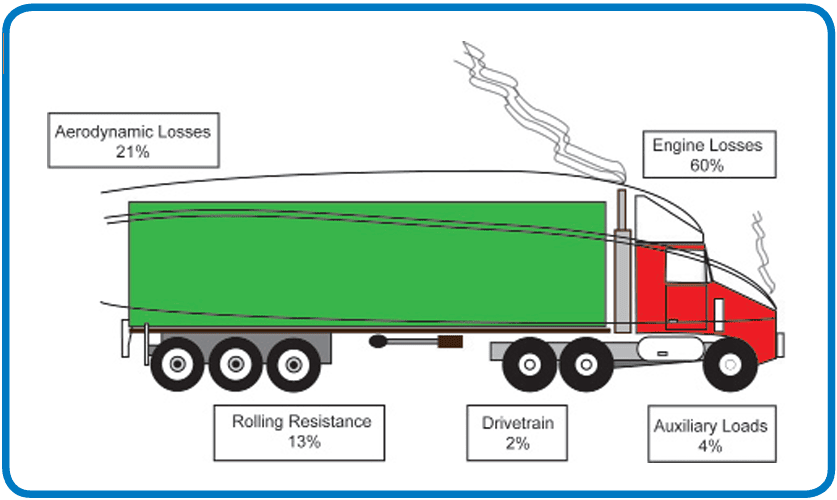
Most fuel energy is lost primarily through the engine, with additional losses from air drag, tyre resistance, with smaller amounts from the drivetrain and from auxiliary systems like air conditioning.
What fleet managers can do now
While there’s little that can be done about engine losses, rolling and air resistance can be kept to a minimum.
According to SAFED;
“As much as 80 percent of the fuel economy benefits for a combination unit tractor comes from just three parts of its aerodynamic air-management equipment: the roof-mounted air deflector, side panels at the rear of cab, and the under-bumper air dam.”
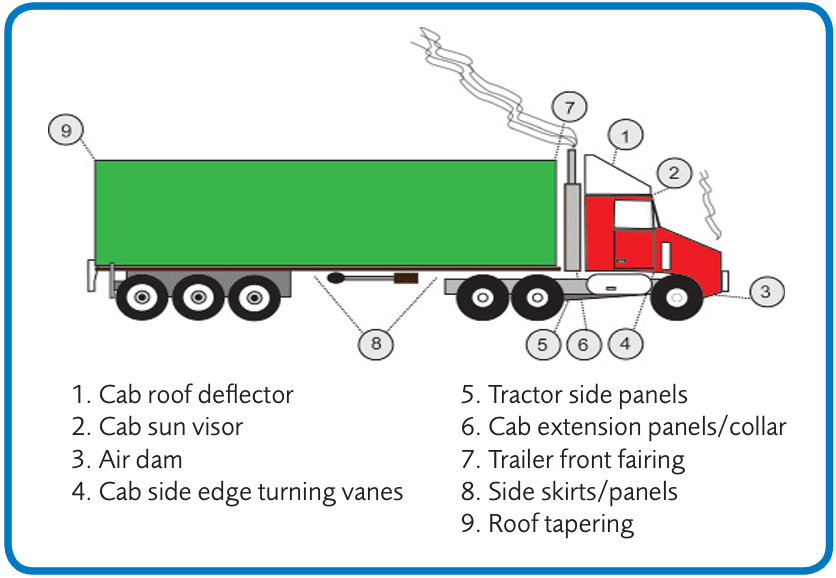
This diagram shows some practical aerodynamic add-ons that improve fuel efficiency. Cab roof deflectors, side panels, air dams, trailer fairings, side skirts, and roof tapering are designed to smooth airflow around the vehicle and reduce drag.
For fleets that may not yet have these features, retrofitting can deliver noticeable fuel savings on long-distance, high-speed routes where aerodynamic resistance has the greatest impact.
If you’re not already using telematics, now’s a good time to start. There are a range of fleet tracking systems available that can help you save on fuel costs. This article from EROAD explains how.
SAFED also recommends strategies such as implementing ongoing training programmes or incentivising fuel efficiency through driver bonuses or league tables based on fuel economy averages.
Most importantly, you’ve got to know your costs. You can’t manage what you don’t measure.
Additional resources
There’s a basic template for cost tracking on page 6 of this booklet. You can also find Transporting New Zealand/Lock Finance’s cost tool and the Grant Thornton Cost Index in our membership portal.
The full Saving Fuel booklet from SAFED can be found here.
Images sourced from:
Saving Fuel: Safe and fuel efficient driving tips for trucks and buses. (2010). Ministry of Transport.