
Heavy traffic data proves high cost doesn’t translate to less freight moved

Progress on driver fatigue management
Today we’re celebrating Transporting New Zealand’s 60th Anniversary Conference at Parliament, and I’m looking forward to catching up with so many members, industry leaders and stakeholders throughout the day.
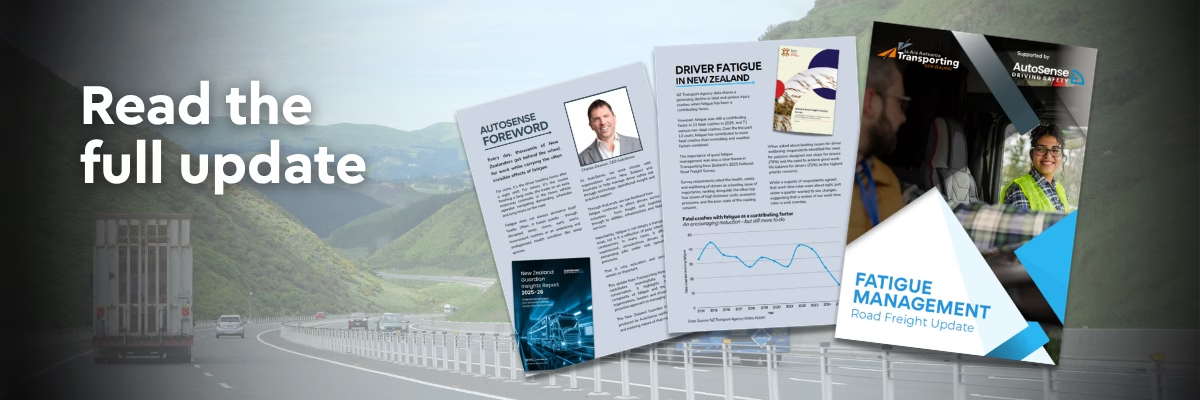
One of the highlights is the launch of our Fatigue Management: Road Freight Update, produced with the support of AutoSense.
The Update shows encouraging progress, with fatal road crashes where fatigue was a contributing factor declining steadily over the last four years. It also identifies practical opportunities to reduce fatigue risk even further, including better roadside rest stop facilities, greater uptake of Alternative Fatigue Management Schemes, and the use of fatigue detection technology.
If you’re joining us at Conference, you’ll be able to pick up a copy there. If you can’t make it, the report is now available on our website.
Another silver lining to the fuel crisis cloud
Given the challenges our industry has faced with fuel pricing over the last few months, I’ve been fascinated to watch what’s happening with heavy vehicle activity both here and overseas.
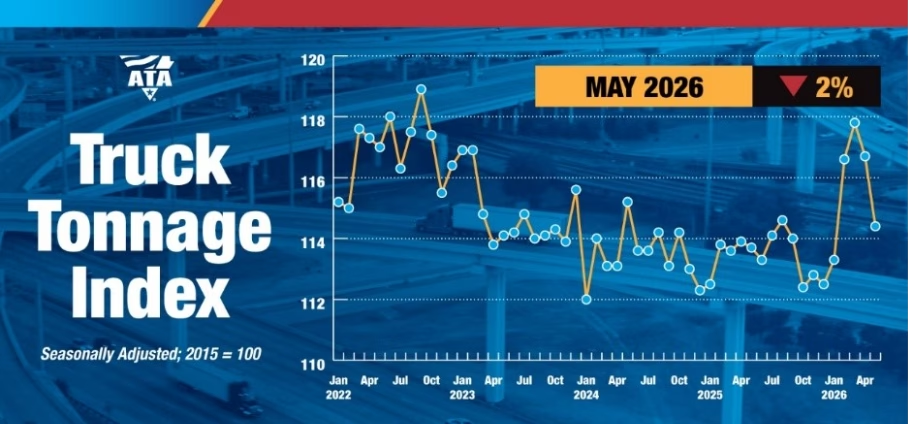
In the US, the American Trucking Association’s Chief Economist Bob Costello reported that truck tonnage fell 2% in May, and after a total gain of 4.7% during the first three months of the year, tonnage fell a total of 2.9% during the last two months.
Unfortunately, we don’t have direct comparisons easily available in New Zealand but in the absence of that, I find ANZ’s Truckometer and its Heavy Traffic Index useful as there should be a reasonably good correlation between tonnage and heavy vehicle kilometres travelled.
ANZ’s Heavy Traffic Index shows a negative 1.3% change for May 2026 and an annual percent change, 3-month average of 1.9%. What’s more interesting is that figures for the previous corresponding period reported in May 2025 were negative 2.2% for the month and 1.6% for the 3-month average.
We have just gone through a period of unprecedented increase in transport costs. But regardless, the Truckometer shows that demand and activity are not that different from this time last year – in fact, it’s slightly better!
Why that fascinates and excites me is because it clearly demonstrates the inelasticity between price and demand. When fuel prices started increasing, we had a number of discussions with government officials about what might happen. Despite our advice to the contrary, officials believed this would be a period where our industry could become much more efficient and activity would decrease. Efficiency improvement gains of around 20% may eventuate. There were views expressed that more road freight would shift to rail and coastal shipping.
We argued that while there may be some stuff at the margins, by and large transport operators are already operating efficiently, and unlocking substantive productivity gains would therefore require changing the regulations.
This week we’ve had similar discussions with media on congestion pricing. Trucks typically travel at the time they do because it’s necessary to meet customer demand. Charging them to travel during peak travel times will do little to change that behaviour.
Uncertainty around fuel pricing remains, and I don’t doubt that will continue to cause stress for our members. However, I think what’s happened with transport activity clearly shows how crucial road transport is. Hopefully these learnings provide a good silver lining to the dark cloud we’ve faced.



Didn’t get this by email?
Stay in the loop on the latest road transport news with our weekly Dispatch newsletter, delivered to your inbox every Friday morning.