
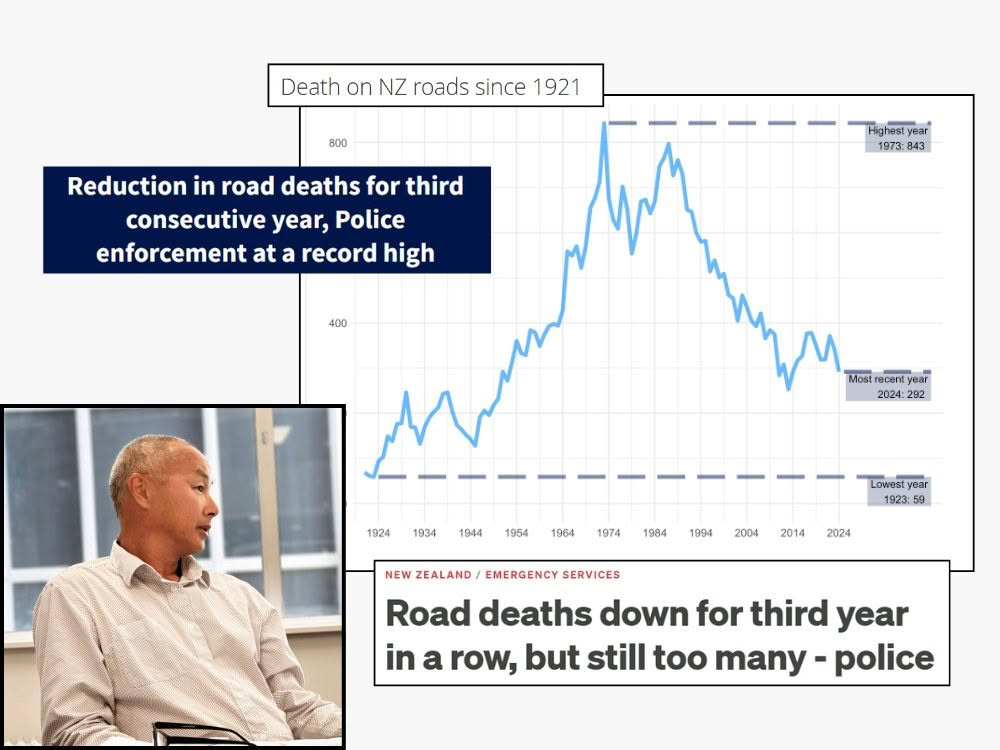
Many of you may have read or heard mainstream media reporting the continued decline in the annual road toll. Ministry of Transport figures show a decline over the last four years with 272 deaths in 2025, down from 292 in 2024, 342 in 2023, and 371 in 2022.
I’m always mindful of the famous phrase “Lies, damn lies, and statistics,” which highlights how numerical data can be manipulated or misinterpreted to support weak arguments. To demonstrate these kinds of vagaries, while there were 20 fewer total fatalities in 2025 compared to 2024, there were 10 more fatal crashes in 2025. However, I tend to look at trends over time and on that basis, I think these results do show that something is working well.
Before 2024, the last time the road toll was below 300 was in 2014 and 2013, with 292 and 253 fatalities respectively.
Police credited tougher and targeted enforcement for the continued decline. I agree that that’s highly likely to have majorly contributed to this achievement.
Considering data and trends like this is important because a significant amount of money, public and private, is invested in improving safety. Understanding what actually makes a difference is important.
Given the complexities and resource associated with analysing the data, NZTA and the Ministry of Transport are typically one year behind. Putting aside that lag, it is still very useful to look at the deaths involving trucks as Figure 1 shows for the period 1984 –2024.
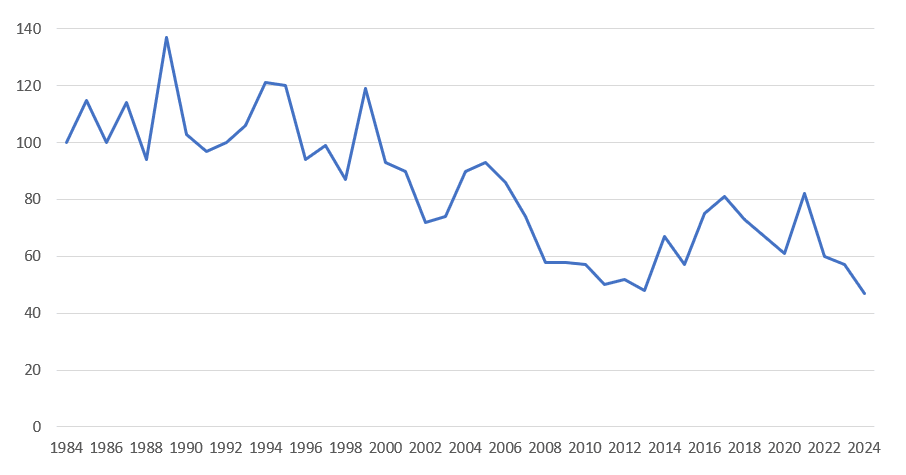
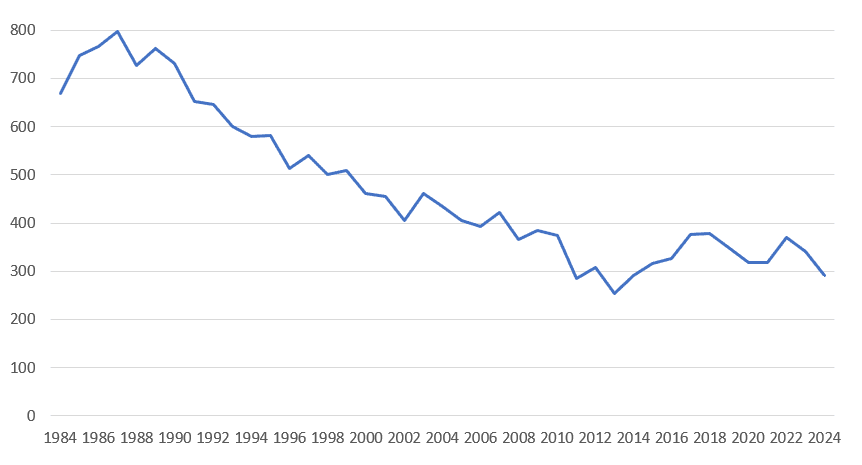
What’s interesting is the general downward trend until around 2013, followed by a period to 2024 that saw the trend increasing, and then decreasing again overall – fluctuating wildly year on year. Even more interesting is that a very similar trend occurred with deaths across all vehicles as shown in Figure 2.
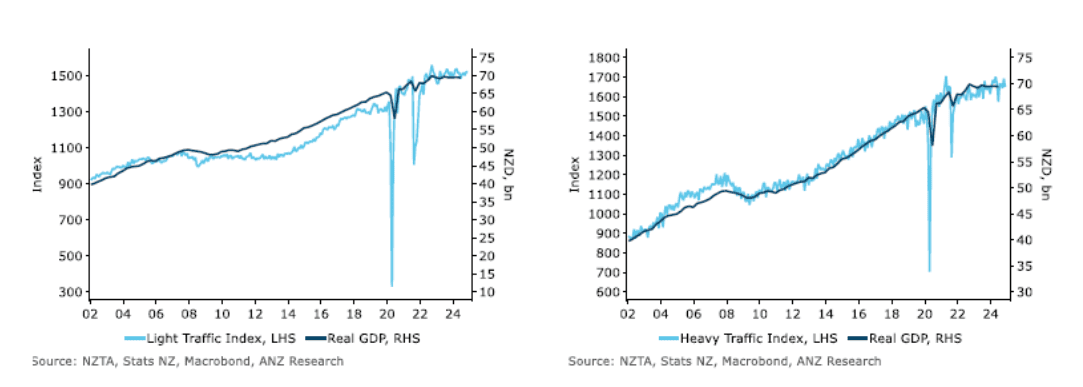
There trends have occurred while traffic for both light and heavy vehicles has increased over time, as shown by the light blue line in ANZ’s Truckometer in Figure 3.
While I agree that Police will have played a key role in the reduction in road deaths, I cannot say with any confidence what the other main contributing factors underpinning this performance are. But it is something we will be trying to better understand this year to ensure we’re putting our resource towards the most impactful, evidence-based changes.
It’s also important because based on media commentary last year, one might think that trucking safety performance was getting worse. The reality is that the number of fatal crashes involving trucks in 2024 was the lowest number recorded in the previous 40 years.
I’ve heard the catch-cry advice of “Stay in the mix in 2026”, so while there are signs of economic recovery, it’s still going to be a challenging year. We must manage the risk of knee-jerk reactions, poor policymaking and unnecessary compliance costs.
A good example of a what I saw as a knee-jerk reaction and poor policymaking was in the US towards the end of 2025. Following “safety concerns” the Federal Motor Carrier Safety Administration in the US imposed heavy restrictions on thousands of commercial licences of non-domiciled drivers.
The U.S. Court of Appeals for the District of Columbia has subsequently put a halt to that. The judges pointed to the agency’s own admission that it lacked “sufficient evidence, derived from well-designed, rigorous, quantitative analyses, to reliably demonstrate a measurable empirical relationship between the nation of domicile for a CDL driver and safety outcomes in the United States.”
The court specifically cited FMCSA’s data showing that non-domiciled CDL holders account for roughly 5% of all CDL holders but only about 0.2% of all fatal crashes.
Like most in our industry, I want our safety to keep improving, but let’s do this rationally and sensibly.
Best wishes for a successful 2026.